Showing posts with label local news. Show all posts

Friday, August 28, 2009

Delicious Today: digital storytelling, emotional geography

Today is the last day of my summer internship at CPB. I have had a wonderful and productive time here. I'll keep posting "Delicious Today" on a weekly basis. Thanks for reading and sharing.

#1: Jim Gaines: Magazines Need to Embrace Multimedia Storytelling in Digital Age
#2: FLYP: multimedia magazine
"Gaines has had a long career in magazine journalism. ... Gaines came back to long-form publishing with Flyp Media, an online publisher of magazine-style content that combines video, audio, Flash animations and interactive features. Flyp was created as a proof of concept, financed by Mexican media mogul Alfonso Romo, and is only now starting to look for advertising and business partners."
I tried a few stories on the FLYP website and think it's one of the best digital storyteller I've ever seen. The design is sleek and clean. The delivery technology is easy to use and intuitive. It's really like reading a print magazine. You even get that "whoosh" sound when you flip (click) from page to page. But best of all, the multimedia components -- audio, video, animation -- are used judiciously thus feel natural as part of the storytelling. This is a rare case of happy marriage between content and technology: they seem to have surpassed the stormy early years of marriage and evolved into a comfortable partnership. Public broadcasters have a lot to learn from FLYP's experiment.

#3: Emotional Geography explained by Daniel X. O'Neil of EveryBlock
#4:
Emotional Geography: list of resources
"Emotional Geography is a concept I’ve had for a web-based application that allows people to create customized maps with highlighted points of personal interest."
This is an intriguing idea for public broadcasters to rethink what "local" means and how to serve different "local audiences." When technology has broken down the barriers of space in communication, local stations need to get out of the habits of thinking local only as a physical location, and thinking audience only as residents living in that location. We all have multiple "local" communities: our neighborhood, our friends scattered around the country and the world, our work connections who reside in one industry but many geographical locations, etc. So the concept of emotional geography makes a lot of sense and should be helpful in stimulating new programming and growth strategies for stations. Take the Washington Post for example, it "has begun to embrace the idea of defining itself not as the newspaper of Washington, the physical entity, but as Washington, the idea."

Wednesday, August 19, 2009

Delicious Today: $$, local, BBC

#1: "Silly Season" Summer Roundup: Squeezing the Value From Online Content
"I divide the numerous 'value from content' plans into four general categories: (a) the paywall, (b) tracking users for ads (c) tracking content for extraction (d) reinstate online scarcity via legal doctrine."
This is a well-written but incomplete overview of business models in trial for digital media. It (especially point a and b) gives a nice and brief summary and analysis of the action on commercial side of action. On the non-profit side, to my observation, people are also trying the following models:
  • Membership: users purchase membership for experience or benefits. E.g. Folk Alley, Guardian.
  • Commission: users commission the coverage of a story by paying part of its cost. E.g. Spot.us, PublicPress
  • Foundation: operation is fully supported by a foundation. E.g. Kaiser Health News
  • Subsidy: non-profit part of the operation is supported by its commercial part. E.g. BBC Worldwide, the main commercial arm of BBC, generates revenue and re-invest part of it in BBC's public service programming.
#2: Beyond advertising: Choosing a strategic path to the digital consumer, by IBM
This 2008 online survey studied the shifting demands of digital consumers in six countries, and offered strategy suggestions to content owners, media distributors, and agencies. Three categories of consumers have emerged from the study:
  1. Massive passives: slow adopters
  2. Gadgetiers: early adopters, cash rich, time poor
  3. Kool kids: youth, quick adopters, cash poor, time rich
Public broadcasters are content owner first, media distributors second. We often use audience demographics and VALS (Values And LifeStyles) to guide our business strategy. Now we have one more tool to help us.

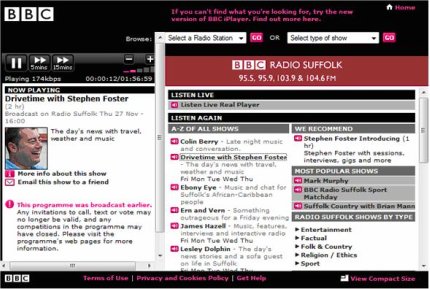
#3: Improvements to BBC Local Radio online
#4: BBC iPlayer Local Radio Integration
"You will see we are no longer purely in the land of software. We are now into setting up new processes, re-engineering the business chain and finding people to use these tools to put together a consolidated data view of a Local Radio schedule which could drive interactive services."
This is a detailed account how BBC finally integrated all 40 local stations' audio and schedule content into iPlayer, BBC's sleek multimedia player. There are plenty of not only technical but also organizational and business challenges. BBC's experience provides valuable insights and lessons to American public broadcasters as we, as individual stations and as one collective system, are searching for more effective ways to deliver content and serve the audience.

Monday, August 17, 2009

Delicious Today: local, social news, $$

#1: Msnbc.com acquires local news Web site: Chicago-based EveryBlock will continue as independent brand
EveryBlock "allows users to type in their address, neighborhood name or ZIP code to view nearby news coverage, blog entries, civic data, photos and dozens of other types of information — all updated throughout the day."

Even though it covers only 15 big cities, EveryBlock is a rare example of data-mining journalism that digs deep into government and public databases (using technology and people) to create useful and meaningful local content. It has invented a new form of journalism practice that's native digital journalism. The significance could be like that of camera movement for movies. Early movies often repackage theater performance for screens using a fixed movie camera. Then people discovered the wonder of moving cameras, and a new form of visual storytelling was born. Most of the online journalism today is still in the repackage phase. EveryBlock's data-mining journalism is an exciting step into the next phase. Now empowered by MSNBC's vast resources and market space, EveryBlock can really go far in its exploration of native digital journalism.

Public broadcasters need to be aware of, if not engage in, the latest development in journalism practices such as data-mining journalism. Being an early adopter is costly, but it's equally costly if we are not a close follower.

#2: Facebook, Huffington Post Launch Social News Service
"The Huffington Post and Facebook have teamed up to create HuffPost Social News, a service that lets HuffPost users easily connect with friends on Facebook around the news and opinion site."

Social news could be another form of native digital journalism. I tried HuffPost's service but was confused by the site. I don't know exactly what the attraction is and how to navigate it. Let's wait and see how many people will sign up and how they will use it.

#3: The CUNY Nonprofit Model
Should nonprofit news organizations accept advertising? "The City University of New York's New Business Models for News Project is rendering its own verdict: Nonprofits can't afford not to."

Public broadcasters can't run ads on air but can online. This research adds one more reason why we should be more active in finding an effective way of doing it online.

#4: A Social-Network Solution: How investigative reporting got back on its feet
"Most investigative reporting falls into specialized subjects or themes—corruption, human rights, energy and the environment, international security, health and safety, etc. Each of those subject areas is of interest to vast, worldwide social networks of reasonably well-educated and well-informed people—cumulatively, tens of millions of people. ... Now these vast networks became both specialized markets for the work of wire’s international cadre of reporters—exponentially increasing wire’s Web traffic—and pathways to new information resources, crowd-sourced experts, and potential citizen muckrakers."

I agree with the author's vision, but the hard part is implementation. Public broadcasters have a vast internal network of journalists and producers. Right now, we don't have to tackle the extremely hard problem of how to use external social networks to aid reporting and distribution. Let's start with an easier and more rewarding one: how do we better utilize our internal network to improve our investigative reporting?

#5: The Role of Research in the NPR.org Redesign
"We feel it's important to share exactly how the perspectives and needs of our radio listeners and web visitors were incorporated into the new site design."

I'm so glad that NPR gave a detailed account of the process of the redesign. The result of a web design is easy to copy, but it may not be what you want if you have a different audience. The key is to understand and own the process. NPR does a great service to other member stations by disclosing the process of their redesign. That is the right way to create a learning organization. I wish more of this will happen in the future.

Monday, August 3, 2009

Delicious Today: local news, Indico, serendipity, $$

#1: Now on YouTube, Local News
YouTube "has created a News Near You feature that senses a user’s location and serves up a list of relevant videos." YouTube sells it as a new source of revenue to TV stations. But stations see it as a potential competitor. "So for now, most of the YouTube videos near you come from nontraditional sources: radio stations, newspapers, colleges" and user generated material.

This is another sign that the competition to monetize local news is intensifying. With its hundreds of local member stations, public broadcasting system has an opportunity and obligation to be a big provider of local news. The key is to figure out a one-stop shop where the public can get their local news easily and quickly, whether the news is about their own community, their far-away loved ones' community, or other location of interests. Each of us has more than one local communities. Right now it's just too cumbersome to manually aggregate local news of those communities by going through each individual local station's web sites of different menus and designs.

#2: Indico News: 'Everywhere news is on the local level and people are the news'
This is a promising example of citizen journalism. "Three features -- setting assignments for another user; 'interview me', where the site will match up users' questions with an expert to answer them; and the ability to tip off contributors about local events they might want to cover -- set the site apart from other citizen journalism efforts. ... A payment system for contributors is also being developed, offering a percentage of the ad revenue generated by any content next to a user's byline."

The article doesn't give out the details/secrets of the site's business model. But interested public broadcasters may want to talk to the site for lessons or even collaboration.

#3: Serendipity, Lost in the Digital Deluge
"WE’VE gained so much in the digital age. We get more entertainment choices, and finding what we’re looking for is certainly fast. Best of all, much of it is free. But we’ve lost something as well: the fortunate discovery of something we never knew we wanted to find. In other words, the digital age is stamping out serendipity."

That's my feeling about the Internet as well: I miss the delight of discovering something when I'm not searching. This phenomenon is similar to what sociologists call "the strength of weak ties": our ingenious ideas or information scoops often come from not strong ties in our personal network such as family and friends, but weak ties such as acquaintance or co-workers who are more likely to have a different information network and perspective. That's why collaboration, with people very different from us, is so important. That's why collaboration across media platforms and organizations is so critical for public broadcasters to survive and thrive in the digital age.

#4: Social Cord: Charge for Content Via Twitter
"New service Social Cord has devised a way to charge your Twitter followers to access premium content": pay via text message rather than credit card.

I doubt that many people will pay to access premium content in Twitter. But the payment via text method is interesting and may be the direction of future. In Japan where mobile use is a decade ahead of U.S., people use mobile to pay for all kinds of thing -- gas, snack in vending machine, etc. This story makes me think that as more people use iPhone or other mobile devices to access public broadcasting content, it may be worthwhile to build a "donation" function in the mobile app. That's a much easier way than donating by phone or online. Entering credit card number online always makes me nervous.