
Showing posts with label business model. Show all posts
Showing posts with label business model. Show all posts
Wednesday, July 7, 2010
Independence from Proprietary Publishing Systems?


Monday, January 18, 2010
Review of Zinio
 In a previous post I praised the "iTunes for magazine," an online newsstand planned by a group of magazine publishers including Time Inc. and Condé Nast. Then I got an email from Zinio and learned that Zinio has already developed such a newsstand that is selling more than 50,000 digital magazines and books in 15 languages. I was really intrigued why the other group is reinventing the wheel. So I did a little digging on Zinio and talked to its Global EVP and CMO, Jeanniey Mullen.
A private company established in 2001, Zinio, according to the San Francisco Chronicle, has about 5 million active customers and powers Barnes & Noble's electronic magazine sales and e-book previews. The business model of the company is to take a percentage of the revenue from magazine sales, Mullen said. But Zinio is not making money yet, according to Globe and Mail.
Zinio is pursuing a "unity" platform that will allow its readers, with no extra cost, to enjoy their digital magazines on any existing and future device, be it computer, smart phone, tablet, or TV with Internet access. To read their magazines on computers and enjoy the full print-link glory and feel, readers are recommended to download Zinio's free reader software. They can also bookmark, take notes, print any magazine page or share a copy with a friend. To read their magazines on smart phones, the readers need to download an app and the iPhone app was released earlier this month.
I downloaded Zinio's reader software, purchased a few free magazines, and read them on my computer. The process is rather simple and pleasant. Zinio's reader software is quite similar to FLYP, another gorgeous digital magazine reader, and the New York Times Reader. But the latter two are built for a single publication. I don't want to spend so much time and storage space on single-use softwares. I would much prefer a more universal magazine reader like Zinio's.
I really like the Unity platform. I can imagine myself flipping through the beautiful pages on my computer, reading bookmarked articles on my smart phone while commuting on bus or waiting in the dentist's office, or showing saved videos from magazines on an Internet TV to guests in my living room.
If Zinio is already serve as "iTunes for magazines," why does another group of magazines, some of them are Zinio's customers, want to start another platform? Zinio's Mullen didn't answer. My guess is that some magazine publishers do not like the Unity platform since it limits the publishers' ability to have different price and access models for different devices. Even though publishers have an alternative choice to use Zinio's "private-labeled newsstands" service to create their own web front (e.g. Four Points) while using Zinio's technology only as a power engine under the hood, the cost may be too high, or the design possibility offered by the power engine may still be too limited for a magazine publisher. It's a power struggle between content providers and distributors. In the off-line world, the struggle often leads to vertical integration of the whole publishing process. We'll see how the struggle plays out in the online world. The same struggle happens in the newspaper industry as well, with NewspaperDirect trying to be the "iTunes for newspapers."
The magazine industry is experiencing the crushing impact of advertisers' migration from print to online. American magazines lost a quarter of its ad pages between 2008 and 2009. One forecast says that in 2012, the industry's ad revenue will shrink 28% from its peak in 2007. Readers are migrating online too. According to the San Francisco Chronicle, from 2005 to 2007, the number of digital publication subscribers grew from 5.2 million to 13.4 million. So the industry is in a hurry to catch up with advertisers and readers, and to come up with a new business model. Will Zinio succeed? Will "iTunes for magazines" succeed? It's hard to say. But the common external threat may force them to join forces to survive. I won't be surprised if Zinio ends up with being acquired by an alliance of publishers for its technology and customer base.
Monday, November 2, 2009
Delicious Today: 2 Business Models for Journalism
I did some research over the summer on journalism business models for CPB. There seem to be five major revenue sources: pay wall, syndication, ads, product subsidy, and membership. Today I came across two successful examples: GlobalPost with its ads-syndication-membership combination model, and Washington Post with its product subsidy model.
#1: GlobalPost generating revenue of $1 million in first year
 online news organization launched in January this year. It has more than 65 correspondents in nearly 50 countries. Its co-founder Charlie Sennott calls the organization "a lifeboat" for serious international news reporting. I'm a bit surprised but glad to see that it's doing so well financially in the first year.
What public broadcasting can learn most from GlobalPost's business model is syndication. We've been putting a lot of effort in underwriting and membership drive, but not enough in syndication.
#2: Washington Post Co. Quarterly Profit Up 69%
The Washington Post company owns Newsweek magazine, Kaplan education services and television properties along with its namesake newspaper. Its print and web publication are losing money, so journalism operation in the company is subsidized by its Kaplan and cable divisions.
What products can public broadcasting use to help pay for its journalism operation?
#1: GlobalPost generating revenue of $1 million in first year
"GlobalPost’s current revenue streams are advertising (sold exclusively in-house), syndication (with partners like CBS and the New York Daily News), and its subscription Passport service."Profiled by the New York Times, GlobalPost is a for-profit
 online news organization launched in January this year. It has more than 65 correspondents in nearly 50 countries. Its co-founder Charlie Sennott calls the organization "a lifeboat" for serious international news reporting. I'm a bit surprised but glad to see that it's doing so well financially in the first year.
What public broadcasting can learn most from GlobalPost's business model is syndication. We've been putting a lot of effort in underwriting and membership drive, but not enough in syndication.
#2: Washington Post Co. Quarterly Profit Up 69%
The Washington Post company owns Newsweek magazine, Kaplan education services and television properties along with its namesake newspaper. Its print and web publication are losing money, so journalism operation in the company is subsidized by its Kaplan and cable divisions.
What products can public broadcasting use to help pay for its journalism operation?
Thursday, October 22, 2009
Delicious Today: All Together Now
All Together Now
 ies, serious journalism is in financial crisis. One of the two major newspaper in town, the Capital Times, has abandoned its print operation and gone online only. I'm very glad and relieved to see that these local media competitors have chosen to collaborate at the worst and best time for journalism. The worst time because the traditional business model of journalism is broken with advertisers migrating online. The best time because journalists have never had so many powerful yet affordable technologies at their disposal to reinvent journalism and achieve its highest potential.
I'm also excited to see that UW-Madison is involved in the project. The academic institution can not only bring insights from research to help guide the reinvention of journalism, but also address the needs and desires of journalism in classrooms to educate a new generation of journalists. That's the spirit of Wisconsin Idea that education should be relevant to and have a positive influence on people’s lives beyond the university boundary.
"All Together Now is a collaborative journalism endeavor by news media in Madison, Wisconsin, to produce print, broadcast and online reports on a common theme. ... The inaugural topic of All Together Now aims to look at the difficulties encountered by people seeking access to health care in the Madison, Wisconsin area."I'm delighted to see this collaboration journalism project, right in my city! And hooray, both Wisconsin Public Radio and Wisconsin Public Television are part of it. As in many cit
 ies, serious journalism is in financial crisis. One of the two major newspaper in town, the Capital Times, has abandoned its print operation and gone online only. I'm very glad and relieved to see that these local media competitors have chosen to collaborate at the worst and best time for journalism. The worst time because the traditional business model of journalism is broken with advertisers migrating online. The best time because journalists have never had so many powerful yet affordable technologies at their disposal to reinvent journalism and achieve its highest potential.
I'm also excited to see that UW-Madison is involved in the project. The academic institution can not only bring insights from research to help guide the reinvention of journalism, but also address the needs and desires of journalism in classrooms to educate a new generation of journalists. That's the spirit of Wisconsin Idea that education should be relevant to and have a positive influence on people’s lives beyond the university boundary.
Tuesday, September 29, 2009
Delicious Today: Mobile Use Survey, NYT Custom Feeds
#1: Australian Mobile Phone Lifestyle Index
This is a very easy yet extremely flexible tool. You type any search terms, NYT then assembles all news stories in its archive about those terms into a single news feed for you to subscribe to. I'm a big RSS feed user. But most RSS feeds are dictated by news organizations with categories like "international," "editorial" -- too broad for my purpose. I just want all stories about, say, the future of journalism. I can use Google Alerts to get stories about that, but the results are from general Google search thus include too much junk; and results are delivered only by email, not RSS feed that's much easier to manage. NYT's custom feeds solve both problems.
Public broadcasters need to have our own custom feeds. NPR allows audience to build their own custom podcast. Why not custom feeds, not just for NPR content but for all public radio and television stations' content?
For public broadcasters, two findings in the survey are most relevant.About advertising on mobile phone:
- "77% of respondents used their mobile for a purpose other than voice and SMS.
- Most participants used voice (95%) and SMS (98%).
- 56% of respondents used their mobile phone to get information at least once a month.
- 51% of respondents used their mobile phone for entertainment purposes at
least once a month.
- 21% of respondents said they visit websites on their mobile phone at least once a day, while 25% of respondents said they carry out mobile searches at least once a week.
- Overall, 34% of respondents accessed websites on their mobile phone by typing in a URL, 18% were likely to access the Web using the mobile phone company’s portal and 17% accessed the Web from a text message.
- Only 30% used their mobile phone exclusively for personal use. This result is consistent with previous surveys."
- "39% of respondents stated that they would accept ads on their mobile phone in exchange for free mobile content or special offers (not collected in Survey 3)
- 25% of respondents stated that they would accept ads on their mobile phone (up from 5% in Survey 3)
- 44% of respondents stated that they would accept ads that offer them incentives (down from 55% in Survey 3)
- 36% of respondents stated that they would accept ads from companies with whom they have an existing relationship (up from 8% in Survey 3)"

- More than half of respondents use their mobile phones to get information and entertainment, which means that mobile phone has become another mass media channel alongside newspaper, radio, television, computer. Because mobile phone is a "security blanket" for many people -- can't go anywhere without it -- it's likely that mobile media channel will be the most personal, most programmed, and most customized among all channels. To effectively reach people on mobile, public broadcasters need content and delivery strategies to allow mobile audience to quickly identify content of their interest, and easily assemble a personal stream of content from different programs and stations. One good example is the New York Times' custom feeds prototype (see #2 in this post).
- About a third of respondents are willing to accept ads on mobile. That should give public broadcasters a reason to explore use of ads on mobile as a revenue stream.
This is a very easy yet extremely flexible tool. You type any search terms, NYT then assembles all news stories in its archive about those terms into a single news feed for you to subscribe to. I'm a big RSS feed user. But most RSS feeds are dictated by news organizations with categories like "international," "editorial" -- too broad for my purpose. I just want all stories about, say, the future of journalism. I can use Google Alerts to get stories about that, but the results are from general Google search thus include too much junk; and results are delivered only by email, not RSS feed that's much easier to manage. NYT's custom feeds solve both problems.
Public broadcasters need to have our own custom feeds. NPR allows audience to build their own custom podcast. Why not custom feeds, not just for NPR content but for all public radio and television stations' content?
Wednesday, September 23, 2009
Delicious Today: paywall model
Interesting findings from the paidContent:UK/Harris Interactive poll:
#1: Only Five Percent Of UK Readers Would Pay For Online News
 The fourth finding is most interesting and relevant to public broadcasting. It can be applied to the membership model of public radio and televison stations. For some members like my dear friends Emy and Paul, pledging is a noble thing to do, a civic duty; they don't want any tangible thing in return because that will make the pledge feel like a business transaction. In contrast, some members pledge because they want the tangible gift included in the membership. We have to design our membership model carefully to cater to both types of members.
#1: Only Five Percent Of UK Readers Would Pay For Online News
"If their favourite news site begins charging for access to content, 75% of people would simply switch to an alternative free news source. Just 5% of those readers would choose to pay to continue reading the site. And 8% would continue reading the site’s free headlines only."#2: Readers Prefer Subscriptions To Micropayments
"Per-article fees (ie. micropayments) are the favourite option for 21 percent. A day pass giving unlimited articles within a 24-hour period is favoured by 26 percent. But a subscription of up to a year is the most desired model, supported by 54 percent."#3: How Much Do Readers Say They’d Pay?
"Answer: as close to nothing as they can get away with... That’s a wake-up call to publishers who think their content is worth something - in this day and age, it will have to work hard to earn a fee."#4: Will bundling a newspaper subscription help?
"While only five percent of people who read a news site at least once a month told us they would pay for online access, when you throw in a free or discounted subscription to the printed paper, that rises to a combined 48 percent. ... The message is loud and clear - people continue to believe that touchable products command tangible economic value but, divorced from physicality and its associated costs, that digital content should manifest itself cheaper."
 The fourth finding is most interesting and relevant to public broadcasting. It can be applied to the membership model of public radio and televison stations. For some members like my dear friends Emy and Paul, pledging is a noble thing to do, a civic duty; they don't want any tangible thing in return because that will make the pledge feel like a business transaction. In contrast, some members pledge because they want the tangible gift included in the membership. We have to design our membership model carefully to cater to both types of members.
Delicious Today: membership model
#1: Can Memberships, Clubs, Cruises Keep Media Companies Afloat?
"These new memberships and clubs, which focus on offering services to readers that are largely different than a pay wall, are a byproduct of declining advertising#2: O’Reilly may be an idiot, but his team gets membership conceptrevenues. As a result of that lost income, news organizations are looking at new ways of generating revenue from readers. ... One example of a successful membership model is in place at Minnesota Public Radio."

"There are 16 benefits to being an O’Reilly Premium Member. Some are comical. ... The O’Reilly Premium Membership isn’t especially innovative, in that some Hollywood stars, other celebrities (and especially porn stars), and athletes do the same sort of thing. ... as the news industry ponders news membership models, creating Premium memberships that get you more from a favorite star journalist and access to the person could be worth paying for. ... My gut reaction is that individual premium memberships might be an easier sell than a similar membership for an entire news brand."It seems that the membership concept is catching up in commercial news organizations. Even though public broadcasting has been using it for years, we still need to fine tune it to make it more effective and recession-resistant. As a producer for Wisconsin Public Radio's Here on Earth program, I've been involved in many pledge drives and seen many hits and misses. At this point, deciding what premium works and what doesn't is still more of a hunch than a science. I wish there is an exact and reliable recipe we can follow.
Saturday, September 12, 2009
Delicious Today: quality news, business model, measurement, iPod
#1: In America, No News is Good News
A College junior from Jakarta, Indonesia describes one thing she misses about home while studying in U.S. -- "access to quality news broadcasting."
As a public radio producer, I'm glad to hear that the articl author likes PBS: "'NewsHour with Jim Lehrer' may not be exciting — but at least it doesn’t substitute content for flashing lights."
#2: Lots of Fee Ideas for Media Online
#3: Journalism Online’s charging clients a 20% commission
#4: Google Plans Tools to Help News Media Charge for Content
This collection of articles summarizes the latest activities in developing a paid content business model for the media industry. Journalism Online, a private venture founded by three former media executives, is selling an e-commerce engine that "allows customers to have one easy-to-use account common to all the publishers' websites" by paying an annual, monthly, or per-article fees. Google's micro payment model extends its Checkout payment system, one of the leading systems for online payments. Rupert Murdoch's News Corporation hopes to duplicate the success of its Wall Street Journal, one of the largest paid news Web sites, to other news sites it owns.
#5: Major Media Companies Form Measurement Initiative; ‘Not An Attempt To Replace Nielsen’
 ew visitor every time? How can you tell whether a visitor has paid attention to an ad on a web page?
*** Extra
Another big news item is the new iPod Nano which touts a built-in FM tuner and Live Pause button. More people will listen to radio, I think, but it won't save radio if the radio industry doesn't adapt to the digital age.
A College junior from Jakarta, Indonesia describes one thing she misses about
 home while studying in U.S. -- "access to quality news broadcasting."
"I lament the moment when I turn to the TV Guide channel to find that BBC World, CNN International and ABC (the Australian Broadcasting Corporation) are replaced with FOX, CNN America and CNN Headline News. While the brightly-colored studios, extraneous props and chummy presenters on most American news channels lure me like a moth to flame, the content leaves me feeling uninformed. ... It seems to me that our desire for instant, convenient access to information has been prioritized over depth and greater understanding. ... In a society where commercials are shortened to correspond to short attention spans, it feels like news channels are being run by ad agencies."People want quality journalism even when it's not flashy. That desire is especially strong once they have had exposure to good journalism. I listened to BBC for many years before coming to the United States. I was dismayed by the trashy quality of commercial radio on my arrival in U.S. and thought it was worse than Chinese radio which at least didn't sound like infomercial. The commercial radio hasn't improved much since then and I listen only to public radio (thank goodness). When I need more variety of content, I listen to my iPod with podcasts from BBC, ABC (from Australia), Radio Netherlands, and the Ted conference. I'm sure the article's author and I are not the only people who want more quality journalism. I'm sure most Americans want it too. But why haven't we heard a loud request for more quality journalism from the public? Are they happy with the current state of journalism or is the unhappy audience bypassing American media and has gone straight to non-American sources such as BBC?
As a public radio producer, I'm glad to hear that the articl author likes PBS: "'NewsHour with Jim Lehrer' may not be exciting — but at least it doesn’t substitute content for flashing lights."
#2: Lots of Fee Ideas for Media Online
#3: Journalism Online’s charging clients a 20% commission
#4: Google Plans Tools to Help News Media Charge for Content
This collection of articles summarizes the latest activities in developing a paid content business model for the media industry. Journalism Online, a private venture founded by three former media executives, is selling an e-commerce engine that "allows customers to have one easy-to-use account common to all the publishers' websites" by paying an annual, monthly, or per-article fees. Google's micro payment model extends its Checkout payment system, one of the leading systems for online payments. Rupert Murdoch's News Corporation hopes to duplicate the success of its Wall Street Journal, one of the largest paid news Web sites, to other news sites it owns.
#5: Major Media Companies Form Measurement Initiative; ‘Not An Attempt To Replace Nielsen’
"Tired of waiting for the various audience measurement firms to provide seamless, cross-platform data covering consumers’ total media usage, a group of 14 companies representing all the major TV networks have joined with major advertising agencies and marketers to create the Coalition for Innovative Media Measurement (CIMM)."Lack of good audience measurement has been a bottleneck for digital media development because without quality measurement, we have no clear idea whether an online project is successful, little evidence to persuade investors to give more money, and few arguments to attract advertisers. Even though there are plenty of web visit numbers around, their meaning is debatable and their reliability questionable. For example, how can you tell an accidental visitor from a loyal one whose browser doesn't store cookies thus who appears as a n
ew visitor every time? How can you tell whether a visitor has paid attention to an ad on a web page?*** Extra
Another big news item is the new iPod Nano which touts a built-in FM tuner and Live Pause button. More people will listen to radio, I think, but it won't save radio if the radio industry doesn't adapt to the digital age.
Tuesday, September 8, 2009
Delicious Today: critiquing public broadcasting
#1: Public Radio Me
#2: Membership has its meaning

"Public radio apps (which are some of the best out there), for example, tend to be bundled into menu-filled portfolios of public radio stations and shows ... And if I'm a fan of WHYY (for example) in Philadelphia, don't give me an app that simply replays the station. Give me a choice of streams, including ones not duplicated on-air. Give me an app that brings me more of ME, not simply more of you. ... The reasoI follow Mark Ramsey's blog (hear2.com) and find this post about public radio insightful. It's easy to accept the audience-centric approach to digital media, but much harder to implement it. As media organizations, we have a deeply embedded habit of seeing media from producers' point of view and automatically carry that habit from the traditional to digital media world. That's why it's so important to seek out the viewpoints of outsiders like Ramsey, and better yet, our audience.n we approach this so narrowly is that we have a natural tendency to bundle our assets the way they're bundled in our industry (our 'functional fixedness'), rather than unbundle them according to the tastes of each individual fan. We must configure our apps around that fan's interests rather than our over-the-air stream."

#2: Membership has its meaning

"The membership bar has moved up. It’s not enough to let people give you money and promote you. Now you have to invite them to have a real and meaningful role in what you do, even a sense – if not a stake – of ownership and, consequently, control. ... News organizations, please think about membership. But don’t think if it as merely a revenue opportunity. That is doomed."A journalism professor at the City University of New York, Jeff Jarvis is another media critic I respect and follow. Public broadcasting has been using the membership business model for many years. Donating to and becoming a member of a public broadcasting station have many benefits, some extrinsic and some intrinsic. Extrinsic benefits tend to be monetary (pledge gifts) or utilitarian (convenience of downloading). Intrinsic benefits tend to be psychological (good feeling of doing something right, sense of belonging). In terms of long-term effectiveness, intrinsic values are far more powerful than extrinsic values to motivate action. A community formed around ideas rather than business transactions is stronger and lasts longer. In the digital age when communities have become critical to the success of any product including quality journalism, public broadcasters need to focus more on offering extrinsic values, as Jarvis suggested, in their membership drives.
Thursday, August 27, 2009
Delicious Today: social media, $$
#1: Twitter Yields Uneven ROI for News Organizations Using Automation, Curation, Interaction
#2: New Models, New Challenges
#3: The Good Enough Revolution: When Cheap and Simple Is Just Fine
"Journalists can find success on Twitter by crowdsourcing story ideas and stories, connecting with sources, doing research and more. ... Many people have decried news organizations' use of automated RSS feeds into Twitter. ... They are anything but social and are a poor-man's version of an RSS feed. ... Colonel Tribune, the Chicago TribunThe hallmark of social media is to have social relationships above and beyond business transactions with its users. But building a relationship takes time and care. Thus it's a constant challenge for media organizations to balance the efficiency of computer automation and "humanness" of staff engagement.e character run by staffers, was one of the first to show news organizations the value of curation. ... The Colonel curates interesting content focused on the Chicago area, while also mixing in a healthy amount of interaction with users. The Colonel has paid off for the Tribune, despite the work it requires, because the Colonel has a lot of followers and sends a lot of traffic to chicagotribune.com. ... The big downside of curation is the time it takes."

#2: New Models, New Challenges
"One of the questions we at the Rocky Mountain Independent hear a lot is, 'Did you guys think about operating as a nonprofit?' ... The answer is, yes, we did consider going nonprofit but decided it wouldn’t be sustainable for us in the long term. ... We wanted to be as independent as possible, and that’s why we developed a three-pronged revenue model: advertising, memberships and consulting work."Revenue from consulting work for a media organization? Yes, that's one form of the subsidy business model I covered in my presentation to CPB Radio staff today. Journalism today has to be creative in finding ways to support itself.
#3: The Good Enough Revolution: When Cheap and Simple Is Just Fine
"What consumers want from the products and services they buy is fundamentally changing. We now favor flexibility over high fidelity, convenience over features, quick and dirty over slow and polished. ... And businesses need to get used to it, because the Good Enough revolution has only just begun."The article makes a convincing case that for many products and services, consumers are willing to sacrifice quality. But is it also the case for journalism? Personally I can tolerate poor delivery such as scratchy sound and blurry video, but "good enough" content is not good enough for me. I want the best content possible. It's like going to a restaurant. I can tolerate paper plates and plastic forks, but if the food tastes bland, I'm done with the restaurant and will never go back.
Wednesday, August 26, 2009
Delicious Today: business models
#1: Newspapers find a new way to monetize their journalists
NYT Gold ($365 annual fee):
#2: New York Times to decide how to charge for its website by August"It’s the first time that Times columnists have participated in the newspaper’s three-year-old Knowledge Network, an adult-education program operated in partnership with local universities. ... They’re offering weeklong, largely online courses for Times readers who pay between $125 and $185."

NYT "is deciding between two charging systems – a 'metered' and a 'membership' model. ... The metered model, as the Financial Times uses, gives access without a charge for a certain number of page views. The so-called 'membership model' includes a collection of different privileges and services not available to the non-paying reader."#3: The New York Times Describes Online 'Membership' Plans
"The Times was gauging interest in two premium packages that it calls NYT Gold and NYT Silver. ... The packages carry an annual cost of $150 and $50, respectively, and emphasize behind-the-scenes benefits like newsroom tours, exclusive videos of reporters. ... In this, the new packages repeat the core mistake of the Times' last, abortive effort at premium online content, the TimesSelect opinion section: Assuming people are fascinated with the Times as a brand, and with the deep thinking of its insiders. Really, most Web readers just like the news."So the New York Times is debating whether to adopt the metered model or membership model. Actually they can do both, each one targeting a different reader group. It's interesting to read their proposed membership benefits. Differing only in degrees but not types, both packages offer a mixture of economic benefits and relationship benefits, which may not be the smartest way to attract members. Social psychologists have found that people interact with another party either because the other party can offer them something, or because the other party is part of their social relationship, part of who they are. The economic benefits in the packages (discounts, convenience) will appeal to readers who see NYT no more than a news-seller, their interaction with NYT no more than a business transaction. They won't be interested in those relationship benefits in the packages (newsroom tour, talking to reporters). But readers who view NYT as a trusted friend will. So if I were to design the membership, I would offer two different types of packages: Gold targets transaction-focused readers, and Diamond relationship-focused readers.
NYT Gold ($365 annual fee):
- Free subscription to (A) Kindle version of all newspapers under NYT (NYT, Boston Globe, International Herald Tribune). The regular price for the three Kindle papers is $407.64 per year; or (B) daily delivery of NYT print paper + Kindle version of Boston Globe and IHT. The regular price of NYT home delivery is $384.8 per year. The regular price of the two Kindle papers is $239.76.
- TimesMachine: free access to all NYT archive (already in NYT proposal)
- TimesWire: real-time news alerts (already in NYT proposal)
- Free subscription to (A) Kindle version of NYT + a gift subscription to a friend or family. The regular price is $167.88 x 2 = $335.76 per year; or (B) daily delivery of NYT print paper. The regular price of NYT home delivery is $384.8 per year.
- $100 credit that can be used for NYT store merchandise, TimesEvents tickets, TimesTalk tickets
- TimesInsider: free newsroom tour, etc
"At its base are the many visitors to CQPolitics who pay nothing but who do deliver eyeballs. At the top are those so ravenous for particular slices of news they can use that they will pay $10,000 or more a year for access. In other words, CQ sells various products for various media to audiences who differ not by geography or income but by need. It was doing so well before analysts like Wang and Mignon began preaching the virtues of the “hybrid” model to their sometimes-reluctant clients."This is a long but thoughtful article. The key is to find a sustainable niche area that readers are willing to pay for.
"General news has long been predicated on the idea that people’s primary interest in news was defined by where they lived. But that was never completely so. ... But now, The Washington Post, for one, has begun to embrace the idea of defining itself not as the newspaper of Washington, the physical entity, but as Washington, the idea—just as The Wall Street Journal ... is not about Wall Street, a district in lower Manhattan. ... Once a news organization sees itself as something more than in service of a place, it puts itself in a position to tap into one of the emotional imperatives that sustain the niche sites. ... Journalism’s crisis offers an opportunity to transform the everyday work of journalism from a reactive and money-losing proposition into a more selective enterprise of reporting things that no one else knows."
Friday, August 21, 2009
Delicious Today: data mining journalism, $$
I commented briefly on data mining journalism in Monday's post which has attracted some interest. Today, this topic for some reason pops up again and again in my usual reading of RSS feeds and tweets. Maybe I've stumbled upon something big.
#1: Free the Facts: The Guardian's editor-in-chief on why open data matters
#2: Guardian Data Store: use our content to improve your site
#3: Guardian Data Blog
I'm very impressed by Guardian's vision in this direction and the huge volume of work they have already put in. Data mining journalism requires at least three steps:
It's expensive to start data mining journalism because it takes a lot of time and money to write computer code from scratch to retrieve and present data. But the cost of keep doing it becomes less and less because of code reuse and scale of economy. For this reason, data mining journalism can be a sustainable business model that can draw revenue from two sources: (1) charging readers and/or other media companies for data content which is unique and hard to duplicate; and (2) selling data-mining technology and/or access to other media companies.

#1: Free the Facts: The Guardian's editor-in-chief on why open data matters
#2: Guardian Data Store: use our content to improve your site
#3: Guardian Data Blog
"Comment, as Guardian founding editor CP Scott said, is free. But the second part of his maxim holds equally true for the Guardian today: facts are sacred. ... The web has given us easy access to billions of statistics on every matter. And with it are tools to visualise that information, mashing it up with different datasets to tell stories that could never have been told before. ... That is where the Data Store and the Datablog come in. Every day we will publish the raw statistics behind the news and make it easy to export in any form you like. It is about freedom of information. But it is not a one-way process – we want you to tell us what you have done with the data and what we should do with it. The facts are sacred — and they belong to all of us."#4: The Future Of Work: It’s Data, Baby (NYT)
"The ability to extract stories from a world of increasing and abundant data will be increasingly critical to many industries. Indeed, the opening of U.S. federal government data at data.gov (and the appointment of Sir Tim Berners-Lee to similarly open the UK’s data archives) implies a new societal and cultural importance for data wranglers."#5: Hans Rosling shows the best stats you've ever seen (TED conference video)
"You've never seen data presented like this. With the drama and urgency of a sportscaster, statistics guru Hans Rosling debunks myths about the so-called 'developing world.'"Mark Twain once said that "there are three kinds of lies: lies, damned lies and statistics." Yes, we can't always trust the "statistics" we read in news report because oftentimes it's interpretation rather than data which can involve human errors or, worse, deliberate manipulation. But with data storage price falling down almost to the floor and data analysis technology becoming easier to access and use, we can put more raw data in journalists' and the public's hands and give "transparency" a lot more meaning.
I'm very impressed by Guardian's vision in this direction and the huge volume of work they have already put in. Data mining journalism requires at least three steps:
- Collecting data from government and enterprise database (e.g. data.gov, UN databases), a media organization's own archive (e.g. American Archive project), user contributed data, etc.
- Analyze data focusing on finding interesting relationships, i.e. data as links instead of points
- Tell story from data
It's expensive to start data mining journalism because it takes a lot of time and money to write computer code from scratch to retrieve and present data. But the cost of keep doing it becomes less and less because of code reuse and scale of economy. For this reason, data mining journalism can be a sustainable business model that can draw revenue from two sources: (1) charging readers and/or other media companies for data content which is unique and hard to duplicate; and (2) selling data-mining technology and/or access to other media companies.

Thursday, August 20, 2009
Delicious Today: $$ business models
#1: MSNBC.com to Monetize its Videos Throughout the Web
#2: How To Save Newspapers
#3: Journalism Online Signs First Non-Profit Org
"Seeking to monetize this "off-the-site" consumption of video, the company will soon insert advertising into its embeddable player. ... in doing so, we have a motivation to, and an incentive to, distribute our content broadly and not be in an old model where everyone has to come to our website to view the video."This is an example of "push" strategy that breaks away from the old "pull" or "build a portal" strategy. Instead of spending a lot of resources on pulling users to a media organization's own site (portal), the organization may achieve better return on investment by breaking total content into reasonable smaller pieces, branding them, and pushing them into places where their target audience already gathers. Public broadcasters can definitely use this strategy.
#2: How To Save Newspapers
"Newspapers could find a lifeline to solvency and a return to social purpose in a new kind of business structure called an L3C, or low-profit limited liability company." L3C is 'a structure that encourages foundation investment while allowing a profit. ... The successful creation of newspaper L3Cs is largely contingent on passage of the Federal law, which would effectively expand charitable purposes to include newspapers. ... The L3C is different from a typical nonprofit because it can earn a return, but the social purpose must trump the financial purpose."This is my first encounter with L3C. I find it intriguing and think that it could well be one model for sustainable journalism.
#3: Journalism Online Signs First Non-Profit Org
"Journalism Online, the company founded to help publishers monetize content, is going after non-profit news producers. ... Journalism Online recently announced that more than 170 dailies have signed on as 'affiliate partners.' They partners were not revealed in the press release though the Los Angeles Times found that McClatchy, Tribune and Dow Jones did not sign with Journalism Online. The Milwaukee Journal Sentinel did, reported Nieman Journalism Lab."One way to make a practice or technology industry standard is to have most and key players accept it. JO seems to be doing that by courting both commercial and non-profit media organizations to use its e-business engine. That engine may not the best solution for public broadcasters, therefore there is an urgency for public broadcasters to come up with their own answer about a sustainable business model.
Wednesday, August 19, 2009
Delicious Today: $$, local, BBC
#1: "Silly Season" Summer Roundup: Squeezing the Value From Online Content
This 2008 online survey studied the shifting demands of digital consumers in six countries, and offered strategy suggestions to content owners, media distributors, and agencies. Three categories of consumers have emerged from the study:
#3: Improvements to BBC Local Radio online
#4: BBC iPlayer Local Radio Integration
 This is a detailed account how BBC finally integrated all 40 local stations' audio and schedule content into iPlayer, BBC's sleek multimedia player. There are plenty of not only technical but also organizational and business challenges. BBC's experience provides valuable insights and lessons to American public broadcasters as we, as individual stations and as one collective system, are searching for more effective ways to deliver content and serve the audience.
"I divide the numerous 'value from content' plans into four general categories: (a) the paywall, (b) tracking users for ads (c) tracking content for extraction (d) reinstate online scarcity via legal doctrine."This is a well-written but incomplete overview of business models in trial for digital media. It (especially point a and b) gives a nice and brief summary and analysis of the action on commercial side of action. On the non-profit side, to my observation, people are also trying the following models:
- Membership: users purchase membership for experience or benefits. E.g. Folk Alley, Guardian.
- Commission: users commission the coverage of a story by paying part of its cost. E.g. Spot.us, PublicPress
- Foundation: operation is fully supported by a foundation. E.g. Kaiser Health News
- Subsidy: non-profit part of the operation is supported by its commercial part. E.g. BBC Worldwide, the main commercial arm of BBC, generates revenue and re-invest part of it in BBC's public service programming.
This 2008 online survey studied the shifting demands of digital consumers in six countries, and offered strategy suggestions to content owners, media distributors, and agencies. Three categories of consumers have emerged from the study:
- Massive passives: slow adopters
- Gadgetiers: early adopters, cash rich, time poor
- Kool kids: youth, quick adopters, cash poor, time rich
#3: Improvements to BBC Local Radio online
#4: BBC iPlayer Local Radio Integration
"You will see we are no longer purely in the land of software. We are now into setting up new processes, re-engineering the business chain and finding people to use these tools to put together a consolidated data view of a Local Radio schedule which could drive interactive services."
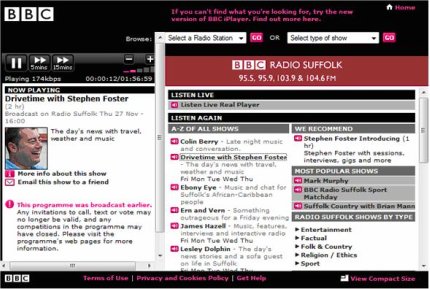 This is a detailed account how BBC finally integrated all 40 local stations' audio and schedule content into iPlayer, BBC's sleek multimedia player. There are plenty of not only technical but also organizational and business challenges. BBC's experience provides valuable insights and lessons to American public broadcasters as we, as individual stations and as one collective system, are searching for more effective ways to deliver content and serve the audience.
Monday, August 17, 2009
Delicious Today: local, social news, $$
#1: Msnbc.com acquires local news Web site: Chicago-based EveryBlock will continue as independent brand
EveryBlock "allows users to type in their address, neighborhood name or ZIP code to view nearby news coverage, blog entries, civic data, photos and dozens of other types of information — all updated throughout the day."
Even though it covers only 15 big cities, EveryBlock is a rare example of data-mining journalism that digs deep into government and public databases (using technology and people) to create useful and meaningful local content. It has invented a new form of journalism practice that's native digital journalism. The significance could be like that of camera movement for movies. Early movies often repackage theater performance for screens using a fixed movie camera. Then people discovered the wonder of moving cameras, and a new form of visual storytelling was born. Most of the online journalism today is still in the repackage phase. EveryBlock's data-mining journalism is an exciting step into the next phase. Now empowered by MSNBC's vast resources and market space, EveryBlock can really go far in its exploration of native digital journalism.
Public broadcasters need to be aware of, if not engage in, the latest development in journalism practices such as data-mining journalism. Being an early adopter is costly, but it's equally costly if we are not a close follower.
#2: Facebook, Huffington Post Launch Social News Service
 "The Huffington Post and Facebook have teamed up to create HuffPost Social News, a service that lets HuffPost users easily connect with friends on Facebook around the news and opinion site."
Social news could be another form of native digital journalism. I tried HuffPost's service but was confused by the site. I don't know exactly what the attraction is and how to navigate it. Let's wait and see how many people will sign up and how they will use it.
#3: The CUNY Nonprofit Model
Should nonprofit news organizations accept advertising? "The City University of New York's New Business Models for News Project is rendering its own verdict: Nonprofits can't afford not to."
Public broadcasters can't run ads on air but can online. This research adds one more reason why we should be more active in finding an effective way of doing it online.
#4: A Social-Network Solution: How investigative reporting got back on its feet
"Most investigative reporting falls into specialized subjects or themes—corruption, human rights, energy and the environment, international security, health and safety, etc. Each of those subject areas is of interest to vast, worldwide social networks of reasonably well-educated and well-informed people—cumulatively, tens of millions of people. ... Now these vast networks became both specialized markets for the work of wire’s international cadre of reporters—exponentially increasing wire’s Web traffic—and pathways to new information resources, crowd-sourced experts, and potential citizen muckrakers."
I agree with the author's vision, but the hard part is implementation. Public broadcasters have a vast internal network of journalists and producers. Right now, we don't have to tackle the extremely hard problem of how to use external social networks to aid reporting and distribution. Let's start with an easier and more rewarding one: how do we better utilize our internal network to improve our investigative reporting?
#5: The Role of Research in the NPR.org Redesign
"We feel it's important to share exactly how the perspectives and needs of our radio listeners and web visitors were incorporated into the new site design."
I'm so glad that NPR gave a detailed account of the process of the redesign. The result of a web design is easy to copy, but it may not be what you want if you have a different audience. The key is to understand and own the process. NPR does a great service to other member stations by disclosing the process of their redesign. That is the right way to create a learning organization. I wish more of this will happen in the future.
Friday, August 14, 2009
Delicious Today: audience loyalty, $$
#1: Seeking: How the brain hard-wires us to love Google, Twitter, and texting. And why that's dangerous
Scientists find that our brains experience two kinds of pleasure: the pleasure of seeking (wanting, curiosity, interest), and the pleasure of liking (enjoyment). The two are complementary. "The former catalyzes us to action; the latter brings us to a satisfied pause."
I can't help thinking that this corresponds to the two kinds of content that public radio provides: talk and music: we're on the right track! Now I also have a better sense why some listeners were so upset and others thrilled when my station cut some classical music time for more Morning Edition. The research can further help us tailor on-air and online content to listeners' different needs.
"By being responsive to comments and acknowledging a mistake, the Post benefited from extra page views, extra time spent on the site, extra registrations and extra comments. "
This is a good example of the value of audience engagement. People who feel their voices heard and valued are more likely to become loyal audience.
#3: No secret to readership: Give them something to talk about
"'Something to talk about' is a powerful motivator that can drive readership. Across all demographics, researchers found similar responses. ... Certainly big news events - just like the weather -- are easy fodder for conversation ... And nothing beats a great story to prompt conversation, even between strangers on a train."
No technology shall diminish the importance of being a good storyteller. Public broadcasting system has many talented storytellers whose craft takes long time to hone and can't be copied easily. They are our competitive advantage and critical to the future of public media: we need them to create quality content, to explore new possibilities, and to mentor the next generation of storytellers.
#4: Building Reader Loyalty
This is a presentation given at Minnesota Newspaper Association convention in January, 2009. It identified four communication needs of audience (slides 10-11): connectivity, information, entertainment, and shopping and consuming.
The nice thing about the presentation is its huge collection of real world examples. The hits and misses of other media organizations should stimulate some ideas for public broadcasters.
#5: My Advice to Fox & MySpace on Selling Content – Yes You Can
Mark Cuban, an Internet billionaire entrepreneur, gave Rupert some interesting advice on how he can sell content online. It's a fun read. I'm most impressed by Cuban's idea of selling bundled products valuable to a specific audience group. For example, he proposed a "newsjunkies subscription" that includes access to multiple news websites owned by Rupert, 2 books from Harpers Collins collection, paper or e-copy of a news magazine, and a discount for DVDs at the Fox Store.
Public broadcasters can't sell content. We have to find other ways to raise money. My take-away from Cuban's article is that we need more entrepreneurial spirit and practice in our search for a sustainable business model in the digital age. Maybe we can allocate a small "venture capital" fund to support and take a chance on a few unconventional projects.
Scientists find that our brains experience two kinds of pleasure: the pleasure of seeking (wanting, curiosity, interest), and the pleasure of liking (enjoyment). The two are complementary. "The former catalyzes us to action; the latter brings us to a satisfied pause."
I can't help thinking that this corresponds to the two kinds of content that public radio provides: talk and music: we're on the right track! Now I also have a better sense why some listeners were so upset and others thrilled when my station cut some classical music time for more Morning Edition. The research can further help us tailor on-air and online content to listeners' different needs.
- Maybe we should follow the example of BBC and ABC (A for Australia) and set up a "channel" system online so that listeners in the mood for seeking won't step on the toes of listeners in the mood for liking. NPR's web redesign is a good start. It separates news and music programs into two separate tabs. But we can go one step further and organize/curate all member stations' content into an intuitive and informative channel system:
- Talk: news, science, arts and entertainment, lifestyle, etc.
- Music: classical, country, pop, etc.
- Kids - Content delivery should also match listener's brain mood: less interruption for music programs and more listener engagement for talk programs.
"By being responsive to comments and acknowledging a mistake, the Post benefited from extra page views, extra time spent on the site, extra registrations and extra comments. "
This is a good example of the value of audience engagement. People who feel their voices heard and valued are more likely to become loyal audience.
#3: No secret to readership: Give them something to talk about
"'Something to talk about' is a powerful motivator that can drive readership. Across all demographics, researchers found similar responses. ... Certainly big news events - just like the weather -- are easy fodder for conversation ... And nothing beats a great story to prompt conversation, even between strangers on a train."
No technology shall diminish the importance of being a good storyteller. Public broadcasting system has many talented storytellers whose craft takes long time to hone and can't be copied easily. They are our competitive advantage and critical to the future of public media: we need them to create quality content, to explore new possibilities, and to mentor the next generation of storytellers.
#4: Building Reader Loyalty
This is a presentation given at Minnesota Newspaper Association convention in January, 2009. It identified four communication needs of audience (slides 10-11): connectivity, information, entertainment, and shopping and consuming.
The nice thing about the presentation is its huge collection of real world examples. The hits and misses of other media organizations should stimulate some ideas for public broadcasters.
#5: My Advice to Fox & MySpace on Selling Content – Yes You Can
Mark Cuban, an Internet billionaire entrepreneur, gave Rupert some interesting advice on how he can sell content online. It's a fun read. I'm most impressed by Cuban's idea of selling bundled products valuable to a specific audience group. For example, he proposed a "newsjunkies subscription" that includes access to multiple news websites owned by Rupert, 2 books from Harpers Collins collection, paper or e-copy of a news magazine, and a discount for DVDs at the Fox Store.
Public broadcasters can't sell content. We have to find other ways to raise money. My take-away from Cuban's article is that we need more entrepreneurial spirit and practice in our search for a sustainable business model in the digital age. Maybe we can allocate a small "venture capital" fund to support and take a chance on a few unconventional projects.
Thursday, August 13, 2009
Delicious Today: audience, $$, Australia
#1: Study: Teens like Headlines and Photos -- But Not 'Dumbed Down' News
#2: What It Takes to be a Web Favorite
Both studies are posted on the Media Management Center at Northwestern University. The first one finds that "teenagers don't like their news watered-down, but rather encourages online news providers to 'be bolder' with their Web sites," and that "teen responses were very similar to those of adults who are light readers." The second one notes that "users form particularly strong habits when it comes to news, ... news Web sites must strive to be on a user's short list of three to five favorite sites or be lost among hundreds of largely overlooked alternatives."
Taken together, these two studies speak the importance for a public broadcasting web site to not only catch audience's attention on their first encounter with the web site, but also becoming their habitual news destination. This requires consistent interesting web content that respects audience's intelligence. The center has a long list of research reports that look useful for public broadcasters.
#3: More Than 170 Dailies Sign On with Journalism Online
"Journalism Online, the company that plans to help publishers monetize content, has signed 176 dailies as affiliate partners. In total, more than 500 newspapers, magazines and other sites have agreed to join Journalism Online representing more than 90 million monthly unique users. Publishing affiliates will be able to select their own pay models" including micro-payment, single account to multiple publications, bundle of print, online and e-reader subscriptions, etc.
This is a substantial development in the movement of paid content. I mentioned Journalism Online in Monday's post. It's impressive that so many publications have jumped on board, but we don't know if they're influential ones since JO has declined to name them. Of course the more important indicator the industry is watching is whether readers will sign up and for what kind of package.
#4: Can Anyone Actually Tap the $100 Billion Potential of Hyperlocal News?
The New York Times and AOL are experimenting in Maplewood, New Jersey. Google's business model, "'a billion dollars, one nickel at a time,' is a perfect description of how media companies hope to take tiny sources of local revenue and roll them up into big money. Hyperlocal sites ... can deliver precision-targeted advertising to local and global businesses. As the once-exponential growth rate for most Internet advertising in the United States grinds to a halt, the online local-advertising market is projected to grow 5.4% in 2009 to $13.3 billion."
With hundreds of member stations across the country operating and deeply involved in their local communities, public broadcasters have a structural, knowledge, and trust advantage over other media organizations in tapping into the online local advertising market. But we should not feel too comfortable or confident because the competitors are coming with deep pockets and technology know-how. We need a strategy and action, now.
 #5: ABC (Australian Broadcasting Corporation) iView
This is ABC's equivalent online TV viewer to BBC's iPlayer. It's very sleek. The program offering is categorized into 9 channels by topics and viewer age groups. But I can't get any content because its copyright allows access to Australian IP addresses only.
PBS has a nice video portal where content is organized by programs, topics, and collections. But compared to ABC and BBC, we don't have a system-wide portal where people can do one-stop shopping and find all programs from all stations, radio or television, local or national. Right now it's really hard to find and sample local stations' programs online unless I manually go through individual station sites or iTunes store. Who has that time? I really wish there was a well-organized public broadcasting online portal. It will (1) provide convenience for audience; (2) help promote programs and grow audience across stations and platforms; (3) encourage internal competition and learning thus more innovation and higher quality content; (4) build stronger collective public media brand name; and (5) offer another efficient fund raising vehicle.
Wednesday, August 12, 2009
Delicious Today: mobile, Kindle, radio, $$
#1: Mobile Internet Use Shrinks Digital Divide
“The report found that nearly half of all African-Americans and English-speaking Hispanics (the study did not include a Spanish-language option) were using mobile phones or other hand-held devices to surf the Web and send e-mail messages. By comparison, just 28 percent of white Americans reported ever going online using a mobile device. Not only are African-Americans the most active users of mobile Internet, they are also the fastest growing group to adopt the technology.”
This is based on Pew data. Since the majority of the public broadcasting audience is white, this trend presents an opportunity for public media to reach minority groups by putting on mobile more content that’s interesting and meaningful for the groups.
#2: My Love/Hate Relationship With My Kindle
“It's a miracle you can walk about with a full library contained in a single, slender device. … But I can see that as an invention, the Kindle's shelf-life is limited. I can't imagine my children wanting one--and that's not because they don't read or dislike books. They have grown up in the online world, which means they are completely comfortable getting most of their information in an online format.”
With its main goal to replace books, Kindle does allow MP3 to play as an experimental feature. I’m not suggesting public broadcasters to spend a lot of effort on pushing content to Kindle. What I take away from the article is that technology platform is audience specific. There’s no one technology platform that can satisfy all kinds of needs and desires of the audience. When deciding on what technology to use to deliver content, instead of going all out to all platforms, public broadcasters should take an audience-centered approach and focus on delivery platforms that the content’s target audience is most likely to use. Less is more here.
#3: Big Radio Reports Big Declines
"A slew of radio broadcasters reported their second-quarter results this week, with little cause for celebration. Led by Clear Channel Communications, the radio groups all posted double-digit declines."
This means that radio listeners are moving elsewhere and public broadcasters need to not only follow them, but also figure out where they're going, why there're going there, and then adjust our content and delivery strategies to meet them and be their listening destination.
#4: How We Got Here and How We Get Out of Here
Kenneth Lerer, co-founder of the Huffington Post, delivered this annual Hearst New Media Lecture at the Journalism school of Columbia University in April. It's about the newspaper industry but a lot of his insights apply to public broadcasting as well. What I like most about his speech is his historical and system-wide perspective about the causes of newspaper's trouble today. The fixes he suggested are still abstract and simplistic. That's very understandable since the lack of obvious and easy fix is exactly what's crippling the newspaper industry.
- "It was obvious that the old assumptions wouldn't hold for much longer. Part of the problem was that these assumptions were embedded into huge corporate structures that weren't built for sharp turns."
- "It's time the industry got comfortable with the idea that media today is a networked/ecosystem. It's all about originating, aggregating, curating, linking, and spurring conversations. Why? Because users want it this way."
- "Ubiquity is the new exclusivity. The way for newspapers to be somewhere is to be everywhere."
Tuesday, August 11, 2009
Delicious Today: business models for online journalism
#1: Pitfalls of the pay wall
A very thoughtful essay. The author asks local publisher or editor to ask five questions before charging for content:
 #2: Goodbye Guardian. Hello the Guardian Experience
"The Guardian was a life-style, a niche, an affinity group. Whatever the point of entry, somewhere behind a paywall was a beckoning club, privileged access not just to news and comment but to a galaxy of media brands, events, concerts, courses, seminars, conferences, tours and related discounts and dating agencies. To pay was not to read, it was to join."
Guardian has decided not to use the paid content model but is proposing a members' club one. I like the idea a lot: not to sell content, but to sell an experience. Public broadcasting audience always feel a sense of community with their stations and fellow listeners/viewers. During pledge drives, events that give audience more face time with program hosts always do well in raising funds. We could do more of those events. But one drawback is those events take a lots of effort to organize. Are there any easy face-time events we can do or sponsor?
#3: Growthspur Q&A: Supporting local media through networks
Founded by several high-profile media executives, Growthspur is a new company that aims to find and sell business strategies to local news and information web sites. "While ad-based revenue is the most obvious, Growthspur will also investigate e-commerce, couponing, mobile applications and other possible streams of revenue for its partner sites." The company site says that "there’s no upfront cost to local sites for a GrowthSpur partnership. Our revenue model is a service fee on the advertising revenue we help you with."
This article makes me wonder why can't public broadcasting industry have our own Growthspur? While there are some organizations doing research and disseminate knowledge for the industry, we don't have a strong body/place to act as a clearing house for best practices and implement support. There is too much duplication of digital media start-up effort in stations. There is too little learning or "borrowing" from front-runners such as NPR who can't afford or feel comfortable to be the trainer for the whole system. Is it possible to form a public media "growthspur" to provide information, implementation and training services to stations and other non-profit organizations? It can be funded by CPB, by a small membership fee from stations, or by charging for service. In a way, Public Interactive is already providing some of those services, although most of its services are on the technical side and not enough on the business side.
What's your take on this?
A very thoughtful essay. The author asks local publisher or editor to ask five questions before charging for content:
- Will the content behind the pay wall be unique and essential to users?
- What about the competition?
- Is it even possible to put a lid on your content?
- How many users are you likely to lose?
- What is your plan for finding out what people in your community will pay for and providing it to them?
 #2: Goodbye Guardian. Hello the Guardian Experience
"The Guardian was a life-style, a niche, an affinity group. Whatever the point of entry, somewhere behind a paywall was a beckoning club, privileged access not just to news and comment but to a galaxy of media brands, events, concerts, courses, seminars, conferences, tours and related discounts and dating agencies. To pay was not to read, it was to join."
Guardian has decided not to use the paid content model but is proposing a members' club one. I like the idea a lot: not to sell content, but to sell an experience. Public broadcasting audience always feel a sense of community with their stations and fellow listeners/viewers. During pledge drives, events that give audience more face time with program hosts always do well in raising funds. We could do more of those events. But one drawback is those events take a lots of effort to organize. Are there any easy face-time events we can do or sponsor?
#3: Growthspur Q&A: Supporting local media through networks
Founded by several high-profile media executives, Growthspur is a new company that aims to find and sell business strategies to local news and information web sites. "While ad-based revenue is the most obvious, Growthspur will also investigate e-commerce, couponing, mobile applications and other possible streams of revenue for its partner sites." The company site says that "there’s no upfront cost to local sites for a GrowthSpur partnership. Our revenue model is a service fee on the advertising revenue we help you with."
This article makes me wonder why can't public broadcasting industry have our own Growthspur? While there are some organizations doing research and disseminate knowledge for the industry, we don't have a strong body/place to act as a clearing house for best practices and implement support. There is too much duplication of digital media start-up effort in stations. There is too little learning or "borrowing" from front-runners such as NPR who can't afford or feel comfortable to be the trainer for the whole system. Is it possible to form a public media "growthspur" to provide information, implementation and training services to stations and other non-profit organizations? It can be funded by CPB, by a small membership fee from stations, or by charging for service. In a way, Public Interactive is already providing some of those services, although most of its services are on the technical side and not enough on the business side.
What's your take on this?
Monday, August 10, 2009
Delicious Today: online video, content, Twitter, $$
#1: UK: Faster broadband won't make us watch more TV online, viewers tell survey
#2: U.S.: The Audience for Online Video-Sharing Sites Shoots Up
This survey in UK found that "53% of people would not watch more online TV or video clips even with a faster, more reliable broadband connection. Some 29% of the 2,123 viewers surveyed felt that there was "little importance" in being able to watch TV using an online service." The trend of online video watching in U.S. appears to be opposite. A 2009 survey by Pew found that online video "has started move into the spaces that are typically reserved for traditional television viewing."
In the competition for audience between online video and traditional television, online wins in terms of content choice but television scores higher in simplicity. Having to tolerate technical inconvenience to access video, online viewers are much more picky about content and have shorter attention span. For public broadcasters, this means that quality of content should be their concern number one. If a program has no compelling content, putting more episodes or distributing it to more places online will have much less return for their investment than having less but really good content that resonates with viewers.
 #3: Traffic on the Nones
It's a video about Aha, an impressive iPhone app that provides traffic information. Users will never need radio again for intermittent traffic reports. Weather may be another category of content that listeners don't need radio for in the future. What should radio stations respond to it? They should really focus on offering things that nobody else can do better.
#4: Spot.Us, pioneer of crowdfunded journalism, preps for expansion
#5: How Steve Brill pitched newspaper executives on charging for online content — and why they’re buying it
These are two examples of latest search for a viable business model of online journalism. Spot.us asks readers to micro-fund journalism projects at $20 per reader per story. Brill's Journalism Online company is selling an e-commerce engine that "allows customers to have one easy-to-use account common to all the publishers' websites" by paying an annual, monthly, or per-article fees.
Public broadcasters can't really sell their content. But the ideas of crowd-funding and common e-commerce engine are worth thinking about. During public radio pledge drives, I often hear listeners a bit surprised and disappointed that they can't demand to which program their donation should go, because all pledges go to the overall fund of a station. Allowing listener to decide which program their donation (or part of it) should go to may give more incentive for donation and encourage more internal competition among programs thus higher quality content and more innovation. An e-commerce engine shared by stations can not only cut down infrastructure and fund-raising cost, but also allow system-wide innovation more easily.
#2: U.S.: The Audience for Online Video-Sharing Sites Shoots Up
This survey in UK found that "53% of people would not watch more online TV or video clips even with a faster, more reliable broadband connection. Some 29% of the 2,123 viewers surveyed felt that there was "little importance" in being able to watch TV using an online service." The trend of online video watching in U.S. appears to be opposite. A 2009 survey by Pew found that online video "has started move into the spaces that are typically reserved for traditional television viewing."
In the competition for audience between online video and traditional television, online wins in terms of content choice but television scores higher in simplicity. Having to tolerate technical inconvenience to access video, online viewers are much more picky about content and have shorter attention span. For public broadcasters, this means that quality of content should be their concern number one. If a program has no compelling content, putting more episodes or distributing it to more places online will have much less return for their investment than having less but really good content that resonates with viewers.
#3: Traffic on the NonesIt's a video about Aha, an impressive iPhone app that provides traffic information. Users will never need radio again for intermittent traffic reports. Weather may be another category of content that listeners don't need radio for in the future. What should radio stations respond to it? They should really focus on offering things that nobody else can do better.
#4: Spot.Us, pioneer of crowdfunded journalism, preps for expansion
#5: How Steve Brill pitched newspaper executives on charging for online content — and why they’re buying it
These are two examples of latest search for a viable business model of online journalism. Spot.us asks readers to micro-fund journalism projects at $20 per reader per story. Brill's Journalism Online company is selling an e-commerce engine that "allows customers to have one easy-to-use account common to all the publishers' websites" by paying an annual, monthly, or per-article fees.
Public broadcasters can't really sell their content. But the ideas of crowd-funding and common e-commerce engine are worth thinking about. During public radio pledge drives, I often hear listeners a bit surprised and disappointed that they can't demand to which program their donation should go, because all pledges go to the overall fund of a station. Allowing listener to decide which program their donation (or part of it) should go to may give more incentive for donation and encourage more internal competition among programs thus higher quality content and more innovation. An e-commerce engine shared by stations can not only cut down infrastructure and fund-raising cost, but also allow system-wide innovation more easily.
Subscribe to:
Posts (Atom)